
Pre Trip Inspection List for Cdl
A pre-trip inspection is part of every CDL skills test and every safe working day. This printable checklist organises the inspection into the sections examiners and experienced drivers follow — engine compartment, in-cab checks, lights, walkaround, coupling system, trailer and air brakes — with space to note defects, plus a study sheet and a daily vehicle inspection report.
- Instant download
- Editable Word & Excel
- Print-ready PDF
- 7-day refund
7 files · PDF, DOCX, XLSX
CDL Pre-Trip Inspection Checklist Pack
Section-by-section CDL pre-trip checklist, a “what to look for” study sheet, a daily vehicle inspection report, a defect log and a practice tracker.
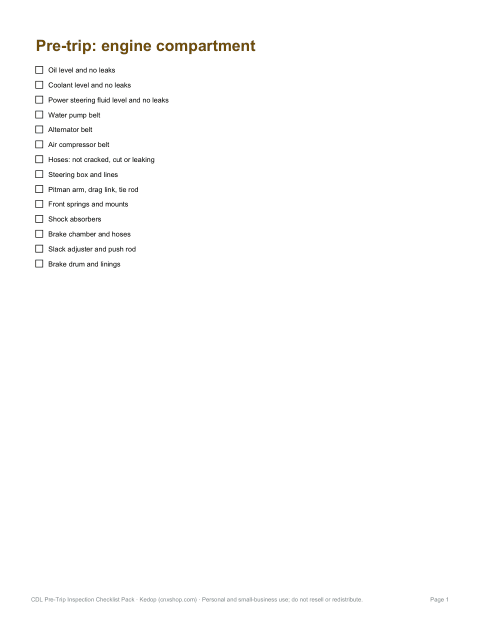
- Engine compartment (PDF, DOCX)
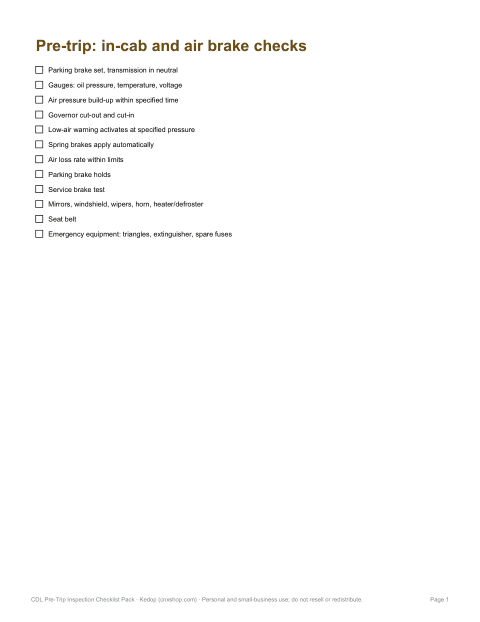
- Cab & air brakes (PDF, DOCX)
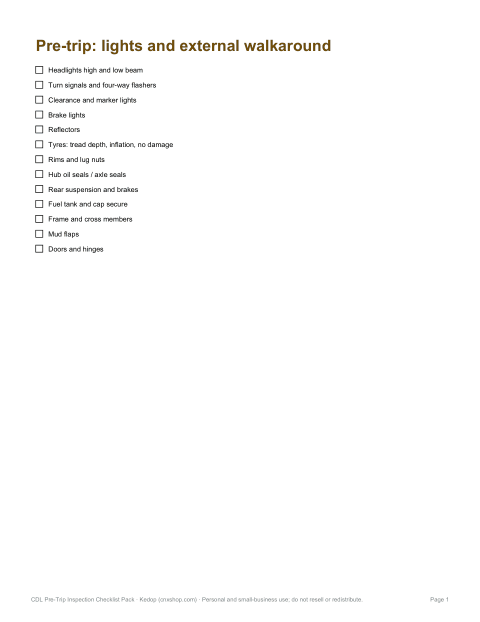
- Lights & walkaround (PDF, DOCX)
- + 4 more
$7.00 USD, one-time 7 files · about $1.00 each
- Instant download
- 7-day refund
- Secure checkout by Stripe
7-day money-back guarantee. Full refund within 7 days of purchase, even after you download.
Free sample: Pre Trip Engine Compartment (PDF, 55 KB)
CDL Pre-Trip Inspection Checklist Pack
Section-by-section CDL pre-trip checklist, a “what to look for” study sheet, a daily vehicle inspection report, a defect log and a practice tracker.
- Engine compartment (PDF, DOCX)
- Cab & air brakes (PDF, DOCX)
- Lights & walkaround (PDF, DOCX)
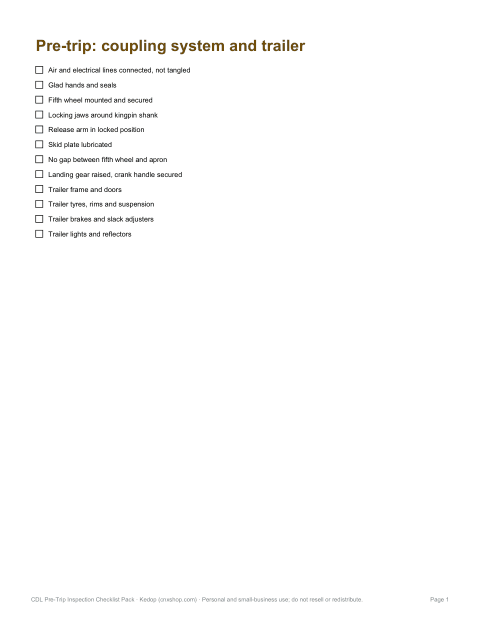
- Coupling & trailer (PDF, DOCX)
- Study sheet (PDF)
- DVIR (XLSX, PDF)
- Practice tracker (PDF, DOCX, XLSX)
Formats: PDF, DOCX, XLSX. Instant download after payment (link valid 72 hours, up to 5 downloads). AI-assisted: the templates were drafted with AI help and reviewed and laid out before publishing.
$7.00 USD, one-time 7 files · about $1.00 each
- Instant download
- 7-day refund
- Secure checkout by Stripe
7-day money-back guarantee. Full refund within 7 days of purchase, even after you download.
Free sample: Pre Trip Engine Compartment (PDF, 55 KB)
Full refund within 7 days — see the refund policy and license.
Free printables
Single sheets you can print right now, no sign-up. The full pack adds every sheet in one download plus the editable files.
 Printable CDL Engine Compartment Checklist1 page · free PDF
 Printable CDL Cab and Air Brakes Checklist1 page · free PDF
 Printable CDL Lights and Walkaround Checklist1 page · free PDF
 Printable CDL Coupling and Trailer Checklist1 page · free PDF
 Printable CDL Pre-Trip Defect Words Sheet1 page · free PDF
 Printable DVIR Inspection Form2 pages · free PDF
 Printable CDL Pre-Trip Practice Log1 page · free PDF
How the pre-trip inspection is organised
Most state CDL manuals, based on the federal model, group the inspection into: engine compartment (fluid levels, belts, hoses, steering components, suspension and brakes at the front wheels); cab check and engine start (gauges, air pressure build-up, controls, mirrors, emergency equipment); lights and reflectors; external walkaround of the tractor (wheels, tyres, suspension, brakes, fuel tanks, frame); coupling system (fifth wheel, kingpin, locking jaws, air and electrical lines); the trailer (doors, landing gear, suspension, tyres, brakes); and the air brake tests. Your state manual is the authority on exactly what to say and check for your vehicle class.
Engine compartment essentials
- Oil, coolant and power steering fluid levels; no leaks.
- Belts (water pump, alternator, air compressor) — not cracked or frayed, with correct deflection.
- Hoses — no leaks, cracks or bulges.
- Steering box, lines, pitman arm, drag link and tie rod — secure, not bent, no leaks.
- Front suspension — springs, mounts, shock absorbers.
- Front brakes — chambers, hoses, slack adjusters, push rods, drums and linings.
In-cab and air brake checks
In the cab you confirm gauges read normally, the air pressure builds within the specified time, the low-air warning activates at the right pressure, the spring brakes apply automatically as air is released, the parking and service brakes hold, and the air loss rate with brakes applied is within limits. These values differ between single and combination vehicles and between state manuals, so learn the exact numbers from your state’s CDL manual and practise the sequence until it is automatic.
What is in the checklist pack
- Section-by-section pre-trip checklist — tick-boxes for each component, grouped as above.
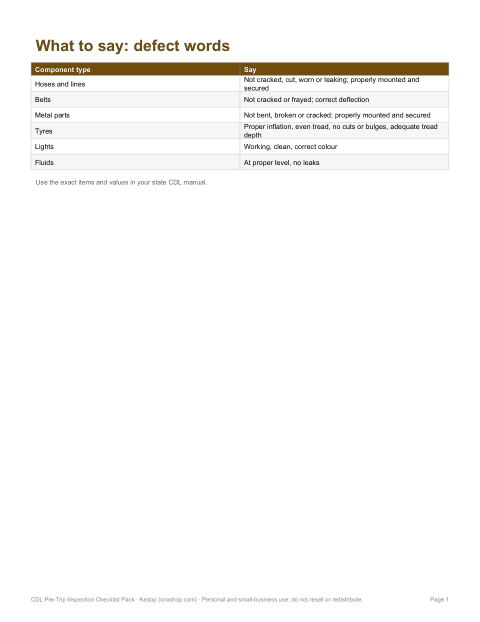
- Study sheet — the “what to look for” words (not cracked, bent, broken; properly mounted and secured; no leaks) that examiners expect to hear.
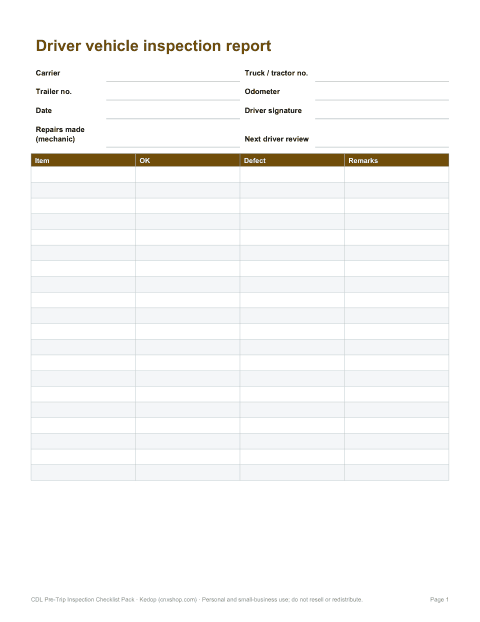
- Daily vehicle inspection report (DVIR) — record defects found before and after a trip, with sign-offs.
- Defect log — track repairs and follow-ups.
- Practice tracker — time each practice run and note sections to review.
Studying for the CDL skills test
- Read the pre-trip section of your state CDL manual carefully; it lists the items for your class.
- Learn one section at a time and say each item aloud as you touch or point to it.
- Use the same order every time so nothing is skipped under pressure.
- Practise on the vehicle type you will test in.
- Time yourself and aim for a thorough, confident inspection rather than speed.
- Practise the air brake test until you can do it without notes.
Examiners typically want to hear what you are checking and what a defect would look like — for example “the hose is not cracked, cut or leaking and is properly mounted and secured”.
Daily inspections after you are licensed
Commercial drivers must inspect their vehicles before driving and are generally required to prepare a written report at the end of each day’s work covering defects affecting safety, under Federal Motor Carrier Safety Administration rules (with some exceptions). Carriers must repair listed defects before the vehicle is driven again, and the next driver reviews the report. A consistent pre-trip routine catches problems — low tyres, air leaks, broken lights — before they cause breakdowns, violations or crashes.
Who it is for
CDL students, trainers, new commercial drivers, fleet safety managers and owner-operators who want a clear, printable routine.
Formats
Checklists are print-ready PDFs (US Letter) and editable Word files; the DVIR and defect log are also provided in Excel.
Important note
This checklist is a study and organisation aid, not an official form or a substitute for your state CDL manual, your employer’s procedures or federal regulations. Requirements vary by vehicle class, endorsements and state. Always follow the current official materials for your test and your vehicle.
Frequently asked questions
What is on a CDL pre-trip inspection?
Engine compartment, cab and engine start, lights, external walkaround, coupling system, trailer and air brake checks.
How long does a pre-trip inspection take?
Often 30–60 minutes during the skills test; daily inspections become quicker with routine.
Do I need to memorise the air brake test?
Yes, you should be able to perform and explain it; learn the values in your state manual.
Is this an official DVIR form?
It is a template that includes the typical DVIR fields; confirm your carrier’s requirements.
Was AI used to create the checklist?
The checklist was drafted with AI assistance from public CDL study materials and reviewed before publishing. Always check your state manual.